Saturday, January 8, 2011

And More Steps

Since I made so much progress with the last step project I thought I would finally build some steps up to the door of the chicken coop. For the last two years I've been high stepping it over the door jam but my old bones are starting to complain.

I used a Home Depot gift card I got (thanks Jason) and got a redwood 4x4 and some block footings and scavenged the rest of the wood from scraps I had lying around the house.

I did all of my calculations and cuts down at the house and then carried it all up the hill. It all went together pretty well and I only had to disassemble one part and put it back together. Not bad.

I can't decide if they look scarier from this angle

or from this angle:

My scraps ran out before I had the whole deck covered. The building inspector wouldn't like it but it works. It will probably take me a couple more years to fill in the gaps. : /


Rather than the "death walk" I like to call the new addition the "observation deck." I was jealous of the chickens view before but now with a 2 1/2 foot boost the view is even better, even framed by the sopote tree heavy with fruit.

Lucky chickens

Now that I've been using theme for a few weeks I think I might have made them too high. I have to bend over to get through the door. I think I preferred the high stepping.

Predator Protection

My first priority when it comes to the chickens is predator protection. Although there are a lot of other things you need to consider to keep chickens happy and healthy, nothing can destroy a flock faster than an animal getting into the coop and killing them.

When I built my coop I was paranoid about coyotes and racoons so I tried to make the coop as impregnable as possible. I used 1/4" hardware cloth on the run and door and even buried it under the ground around the perimeter to keep varmints from digging their way in. So far it has worked and nothing has gotten in.

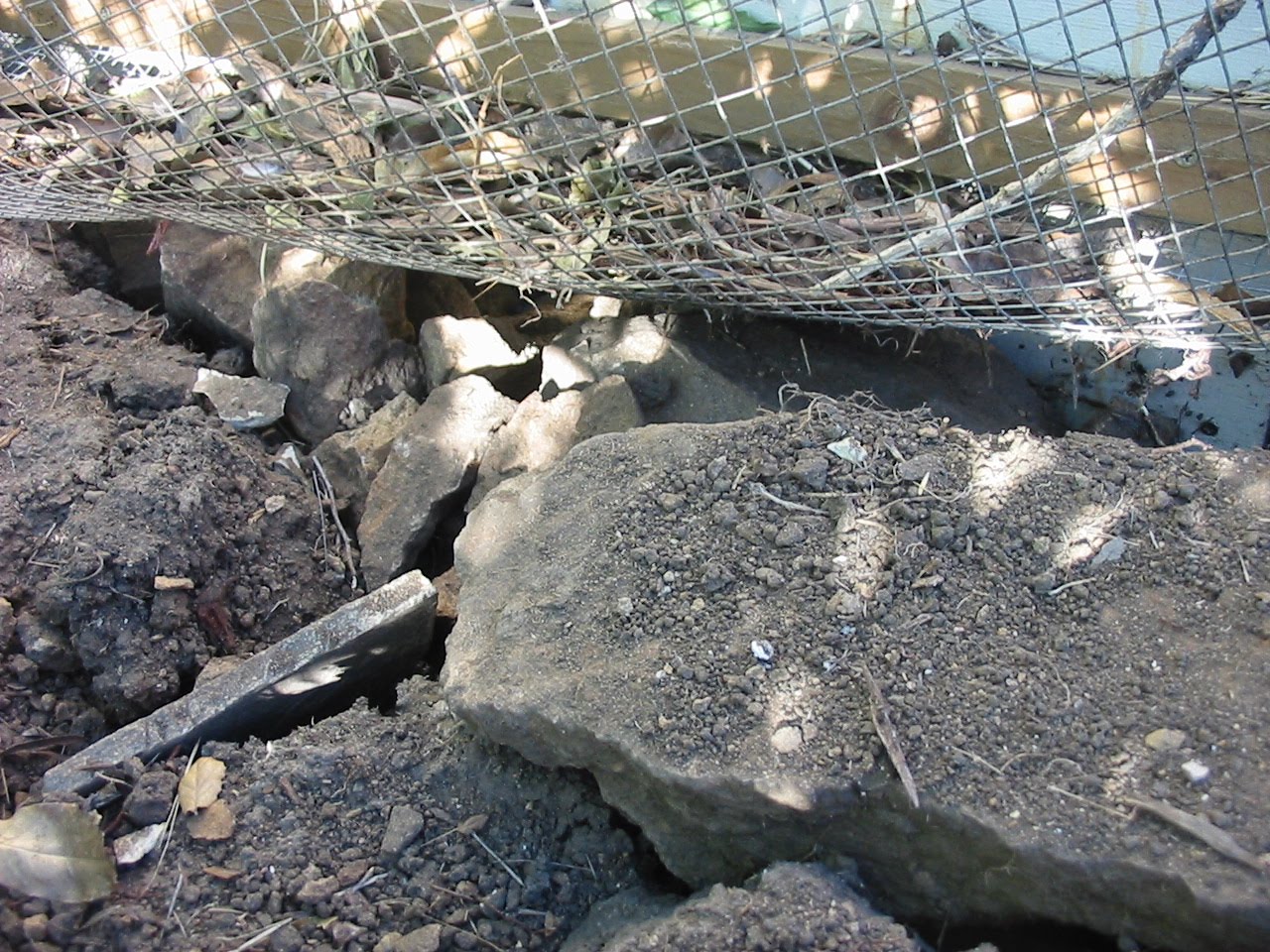
What I didn't plan for was the chickens literally undermining my efforts. All of their scratching in the run has moved enough dirt that there was a visible hole leading to the outside. It was still covered with hardware cloth and I piled some plywood over it but it wouldn't take much for an enterprising racoon to discover it and find it's way in.

Here you can see the section that the chickens had excavated. The whole area under the hardware cloth was an open cavity.


I used pieces of sandstone and concrete that I had dug up while building the lower stairs to fill in the gap.


I also used some of the excess dirt from the stairs to pack it all in tightly.


Here's the view from the inside. I'm hoping that the big pieces of stone will keep the chickens from digging their way out again.


Then I covered the whole business with more dirt. Supposedly most animals will try to dig right up at the edge where the plywood is and will be stymied by the wire mesh under the dirt. So far so good.

Tuesday, September 7, 2010

Fox Tail Agave Update

The fox tail agaves are done blooming and are making a lot of seeds

The seed pods are opening and flinging seeds everywhere.


I wasn't that aware of them until I heard a bunch of rapid tapping out in front of the house. I looked out the window and the chickens were pecking up all the little black seeds.


The mother plants are now totally withered


But there are pups forming on the trunk


and bulbils forming on the tip of the bloom stalk

Monday, September 6, 2010

Tipu Tree Update

This is an update to a post from thee months ago.

This is what the tree looks like now:

It has one new big branch that is growing from lower down on the trunk and then a few smaller branches near the end that broke. Aside from the rough start it seems to have had a good Summer and I'll do my best not to mess with it next year.

No More Vinca

I finally spent some time trying to get the small planting area next to the front stairs under control. In the rainy season it gets covered with Vinca and Oxalis albicans. The Oxalis is a California native but the Vinca is considered an invasive non-native.

Oxalis grows quickly once it rains and gets little yellow flowers on it, but then disappears just as quickly once it dries out. Here's a big patch of it under the pomegranate tree.


The Vinca also grows well when it rains but then sticks around and gets ropy and ugly and covers everything else. Here it is spilling over the stairs.

It catches a lot of debris and ends up looking ratty and unkempt.

Supposedly it was originally planted as a ground cover and because it gets little purple flowers which give it it's common name Periwinkle. But now it grows so tenaciously that it chokes waterways and can alter whole ecosystems. And it can make your stairway look messy. I decided to pull it all out.


Ah, doesn't that feel better?


Now you can see the agaves that I planted in there last year.


I haven't seen this little Agave victoriae reginae in months.

Sunday, September 5, 2010

Winter/Summer

So if you haven't heard, I live on a big dusty hill. I actually find this pretty charming. It's nice to live in the middle of Los Angeles but still be surrounded by so much open space. The summers can be long and dry though and starting around around April, after the last rain, things start to turn brown. The difference between winter and summer can be pretty extreme.

Winter:


Summer:


Winter:


Summer:


Winter:


Summer:


For the most part I've adjusted to this. Our growing season is in the winter and most natives take the summer off to rest. I have come to appreciate the sere beauty of the hills during the hot months, but that doesn't mean that I still don't want to try to grow things on the hill. Of course almost anything will grow here if you're willing to water it, but I'm only interested in growing plants that don't need a lot of supplemental water (I'm cheap and lazy). Luckily there are lots of natives and drought tolerant plants that do well in Southern California.

You can already see a few of them in my yard. I've mentioned that my house was vacant for over a year before I moved in, so anything that required supplemental water had already been selected out. Only the plants that could survive with only winter rains were left. Surprisingly there was a lot left. All of the mature fruit trees seemed to be established enough to make it through the summers and I've already mentioned the intimidatingly successful Solandra maxima. The jade plants also seem to have an interesting strategy where they grow and puff up with water during the winter and then in the summer when they start to shrink they bend over and lay on the ground. Then when the rains come again the prostate sections send roots straight into the ground and the branches continue to grow vertically. Using this flop and advance technique the jade has managed to cover quite a bit of territory in the yard. In the photo below if you start at the ladder and look straight up you see the grass, a lonely yucca besieged by grass, a large jade hedge, a volunteer walnut sapling, a pomegranate tree, a california pepper tree and a white sapote tree.

I appreciate the work that the jade is doing, not only looking pretty and green, but also holding up the hill. In the summer the soil is dry and crumbly and the roots do a good job holding it together. I'm happy when anything grows, as it contributes to the security net holding the hill in place.

That being said, I'm also hoping to add more diversity as the garden evolves. I would love to start incorporating more sages, manzinitas, lavendar and echium, but those cost money. Unlike these:

In the center of this photo are a few Agave americana. These were offsets from a large clump of mature plants on another dusty hill. A. american grows all over L.A. and obviously does well in our climate. There are a few places in my little valley where you can tell that they've been growing for years without anyone tending them. There is one giant specimen on the hill opposite my house that I've been admiring for years. I must be 6' x 6' and stands all by itself on an otherwise empty slope.

I was impressed with the way my army of little agaves was growing until my friend Holly mentioned that she had a bunch of offsets that I was welcome to, but if I wanted them I better come soon before they got too big. Too big? Who could think such a thing? Then I saw them. She had moved some small plants to the back corner of her garden when she moved in 8 years ago. That had been long enough for the babies to mature into big intimidated plants with spreading pups all around them. Holly wanted to keep the planting simple with just the 4 main plants with maybe a pup or two to replace them when they finally bloomed.

I didn't think to get a picture until I was wedge between the thorny leaves trying to dig the pups out. I admit that it was kind of scary standing on a slippery hill with so many black spikes ready to snag anything that got close.


I managed to escape with only a few scratches and it was worth it. This was my haul:

Three big feed bags of agaves, and they are big. The one below is about 5' long (I left the broom in for scale).


I planted three on the hill outside of my bedroom window. This isn't actually my yard but the person who owns the empty lot doesn't expend much effort maintaining it so I figured he wouldn't mind if I planted a couple things, you know, for soil retention. It also makes a nice focal point outside my window.


I have about 15 more that I'll put in pots until I figure out where to put them.

Agave desmenttiana

My friend John gave me a big clump of young Agave desmenttiana that he got from a friend who was running out of room. It was a bit withered and spending a couple of months on my hot patio with bare dirt didn't do it much good.


I separated most of them out to go in their own pots. One day I hope to put them in the dirt in the yard somewhere but I'm slow to make those decisions, so for now they go in pots.


They look even more spindly when they are on their own.


But two months later they are positively surging out of the pots

Not only have they filled out but they have grown at least a couple of inches in height. It's amazing what a little water can do.


I might take this one to work just cuz it makes me so happy to look at it.